Sleipnir is Odin's eight-legged horse, a remarkable figure even in a mythology filled with giants, dragons, and shape-shifting gods. Known for his extraordinary speed, he carries riders across boundaries that ordinary horses cannot cross, including the road to the realm of the dead.
His origins are just as unusual as his appearance. Born to Loki and the stallion Svaðilfari, Sleipnir emerges from a bargain over the defences of Asgard. His story brings together deception, transformation, and journeys beyond the familiar world.
Who Is Sleipnir?
In Norse mythology, Sleipnir is the horse associated with Odin, the Allfather. His name is often translated as “the slipping one” or “the gliding one,” suggesting effortless movement. He is described as grey and distinguished by eight legs rather than the usual four.
The Birth of Sleipnir: Loki and Svaðilfari
The best-known account of Sleipnir's birth appears in the Prose Edda. A builder offers to construct a protective wall for the gods. His demanded payment is extraordinary: the goddess Freyja, together with the sun and moon.
The gods agree to a strict deadline, believing that he cannot finish in time. They allow him the help of his stallion, Svaðilfari, whose strength makes the work advance far faster than expected. As the wall nears completion, the gods demand that Loki find a way to prevent the bargain from being fulfilled.
Loki transforms into a mare and draws Svaðilfari away from the building work. Without his horse's help, the builder cannot complete the task. The deception leads to a confrontation, and the builder's giant nature is revealed.
Loki later gives birth to Sleipnir, the eight-legged foal who becomes Odin's mount. In this story, Loki is Sleipnir's mother, while Svaðilfari is his father.
Sleipnir Odin's Horse Pendant: The Eight-Legged Steed in Bronze
The Sleipnir Odin's Horse Pendant, Bronze gives the myth a wearable form. Made from Italian bronze, this modern pendant depicts Odin's eight-legged horse and keeps the focus on one of the most distinctive creatures in Norse storytelling.
For readers drawn to Sleipnir's unusual origins and association with journeys, it offers a direct connection to the subject through detailed bronze work.
Why Does Sleipnir Have Eight Legs?
The surviving stories do not give a single explanation for Sleipnir's eight legs. His extraordinary appearance sets him apart from ordinary animals and accompanies his reputation as an exceptional mount.
Modern interpretations sometimes connect the legs with speed, movement between worlds, or ritual symbolism.
Odin and Sleipnir: Journeys Beyond the Ordinary
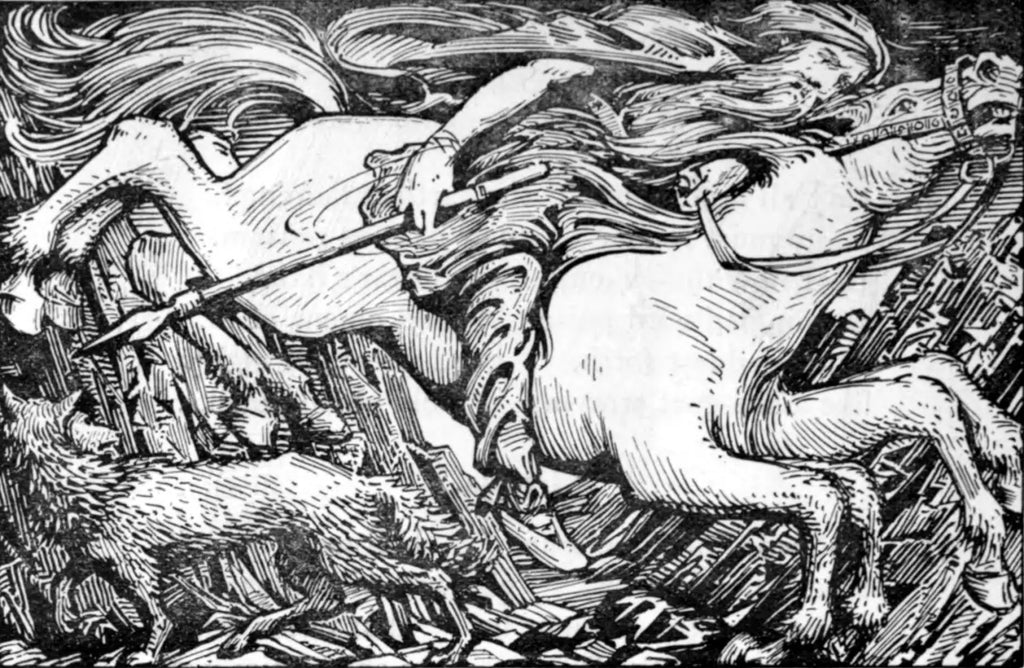
As Odin's horse, Sleipnir travels between the gods' world, the lands of giants, and the realm of the dead.
One tale brings Odin and Sleipnir into a contest with the giant Hrungnir and his horse Gullfaxi. The rivalry between the riders draws the giant into the gods' world.
In the poem Baldrs draumar, Odin rides towards the world of the dead to seek knowledge about Baldr's troubling dreams.
Hermóðr's Ride to Hel
Odin is not the only rider associated with Sleipnir. After Baldr's death, Hermóðr rides the horse on a mission to Hel, hoping to secure Baldr's return.
The journey leads through dark valleys and towards the boundary of the realm of the dead. Sleipnir leaps over the gate, allowing Hermóðr to continue his appeal.
His ability to carry Hermóðr into Hel makes passage between worlds a recurring part of Sleipnir's story.
Sleipnir, Grani, and the Surviving Sources
The Poetic Edda and Prose Edda are central sources for Sleipnir's place in Norse mythology. The Prose Edda preserves the account of his birth, while the poems offer other glimpses of his journeys and reputation.
The Völsunga saga also connects Sleipnir with Grani, the horse of the hero Sigurd, through the idea of descent.
These works survive in medieval written form, with details and translations varying between editions.
Yggdrasil Pendant with Sleipnir and Ravens: A Wider Mythological Scene
The Yggdrasil Pendant with Sleipnir and Ravens, Sterling Silver places the horse alongside other imagery associated with Odin's world. Made in 925 sterling silver, it combines Yggdrasil with Sleipnir and the ravens Huginn and Muninn.
Where the bronze pendant focuses on the horse itself, this design brings several mythological subjects into one composition. It is an alternative for readers whose interest extends from Sleipnir to the wider landscape of Norse stories.
Odin's Horse in Norse Storytelling
From his birth to Loki and Svaðilfari to the journeys of Odin and Hermóðr, Sleipnir appears in stories of transformation, knowledge, and travel beyond the familiar world.
The eight-legged horse continues to feature in retellings of the Eddas, illustrations, and Norse-inspired jewelry.
Written by Stefan. Edited by Northlord.