
A Northlord Seasonal Chronicle
Long before bright markets and polished ornaments filled the winter streets, there were stories whispered in Alpine valleys—stories of creatures who moved through the cold with the weight of ancient judgment on their shoulders. Among them, none is more striking, more unsettling, and more strangely captivating than Krampus, the dark companion of Saint Nicholas.
In the modern world, Krampus is often reduced to a fearsome mascot of December mischief, a horned demon used for dramatic posters or costume festivals. But behind the theatrics lies a legend woven from centuries of belief, ritual, and winter’s psychological landscape. To understand Krampus is to understand how people once coped with the long, hungry nights of the coldest season—how they shaped myths that balanced joy with consequence, warmth with warning.
This is the story of the winter shadow.

The Roots of a Winter Beast
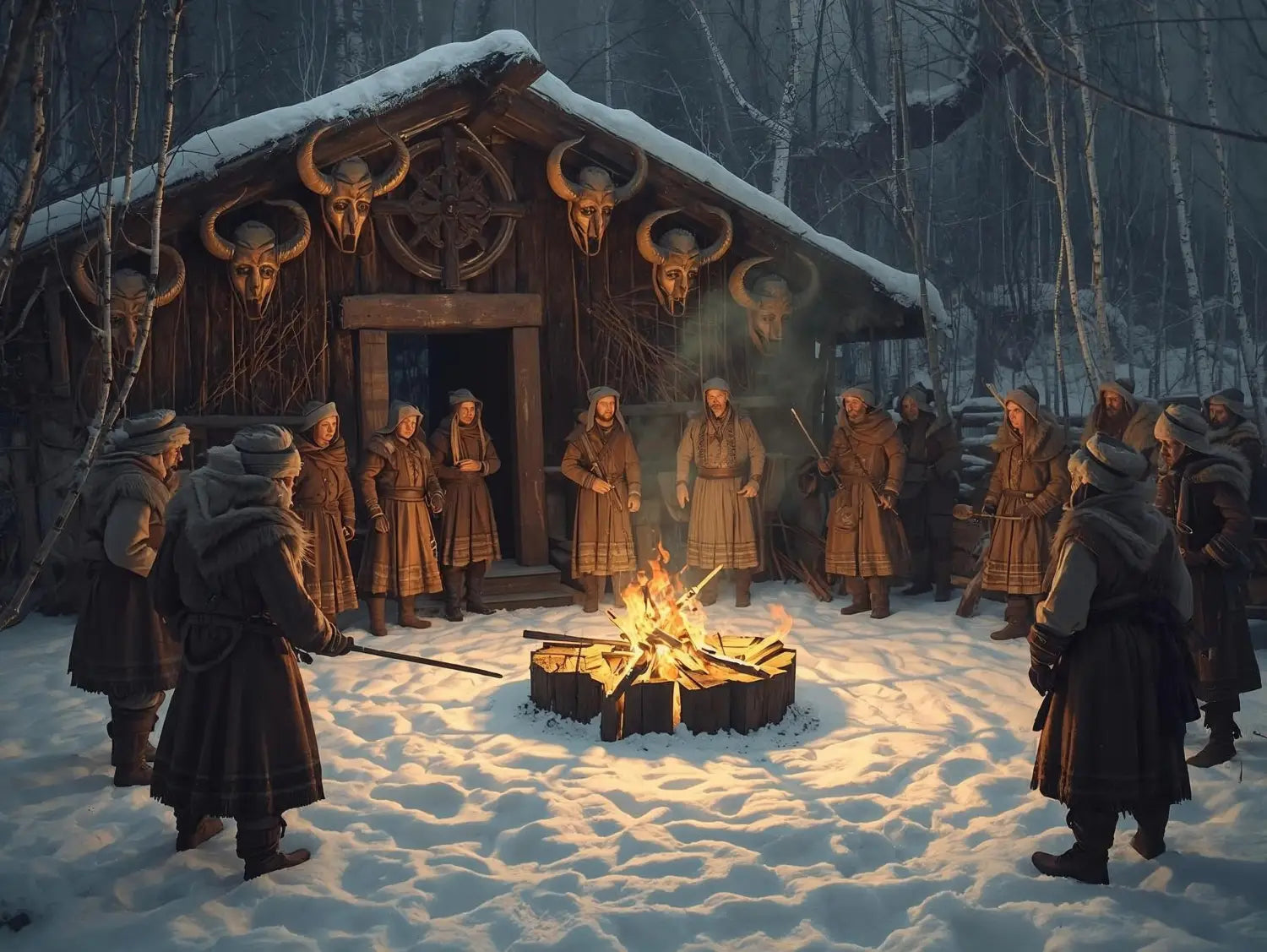
Krampus does not come from Christian doctrine, though he now walks beside a Christian saint. His origins reach deeper—into pagan Alpine traditions, ancient spiritual practices, and the primal fear that winter once brought.
Some folklorists connect Krampus to the old horned gods of the region, to forest spirits who controlled fertility, wild nature, and the unpredictable balance of life and death. Others trace him to household spirits and ancestral beings who punished wrongdoing long before Saint Nicholas ever appeared in European culture.
What is clear is that Krampus was never meant to be evil in the way we imagine “evil” today. He was a force of consequence—a reminder that actions matter, that winter is unforgiving, and that the world is shaped by duality. Light and dark. Reward and discipline. Saint Nicholas and Krampus.
Where Saint Nicholas brought gifts to the deserving, Krampus brought a reckoning to those who ignored morality or respect. Together, they were two halves of the same truth: goodness is rewarded, but wrongdoing has weight.
The Night of the Visit
Traditionally, Krampus appears on Krampusnacht—the Night of Krampus—on December 5th, the eve of Saint Nicholas Day.
In the folklore, the two figures travel from house to house. Saint Nicholas offers gifts, praise, and small blessings. Krampus, meanwhile, carries chains, bells, and a bundle of birch twigs called the Ruten. His task is not to torment children but to correct behavior, to serve as the embodiment of winter’s stern lesson.
The bells on his belt announce his arrival long before his horns appear through the dusk. In some villages, children are told to stay inside on Krampusnacht—not because Krampus hunts them, but because the ritual is meant for adults as well. The clashing bells, the costumes, the roaring masks, the snow trampled by hooves…it was once a communal reminder that winter is harsh, and that only a community that respects its values survives it.
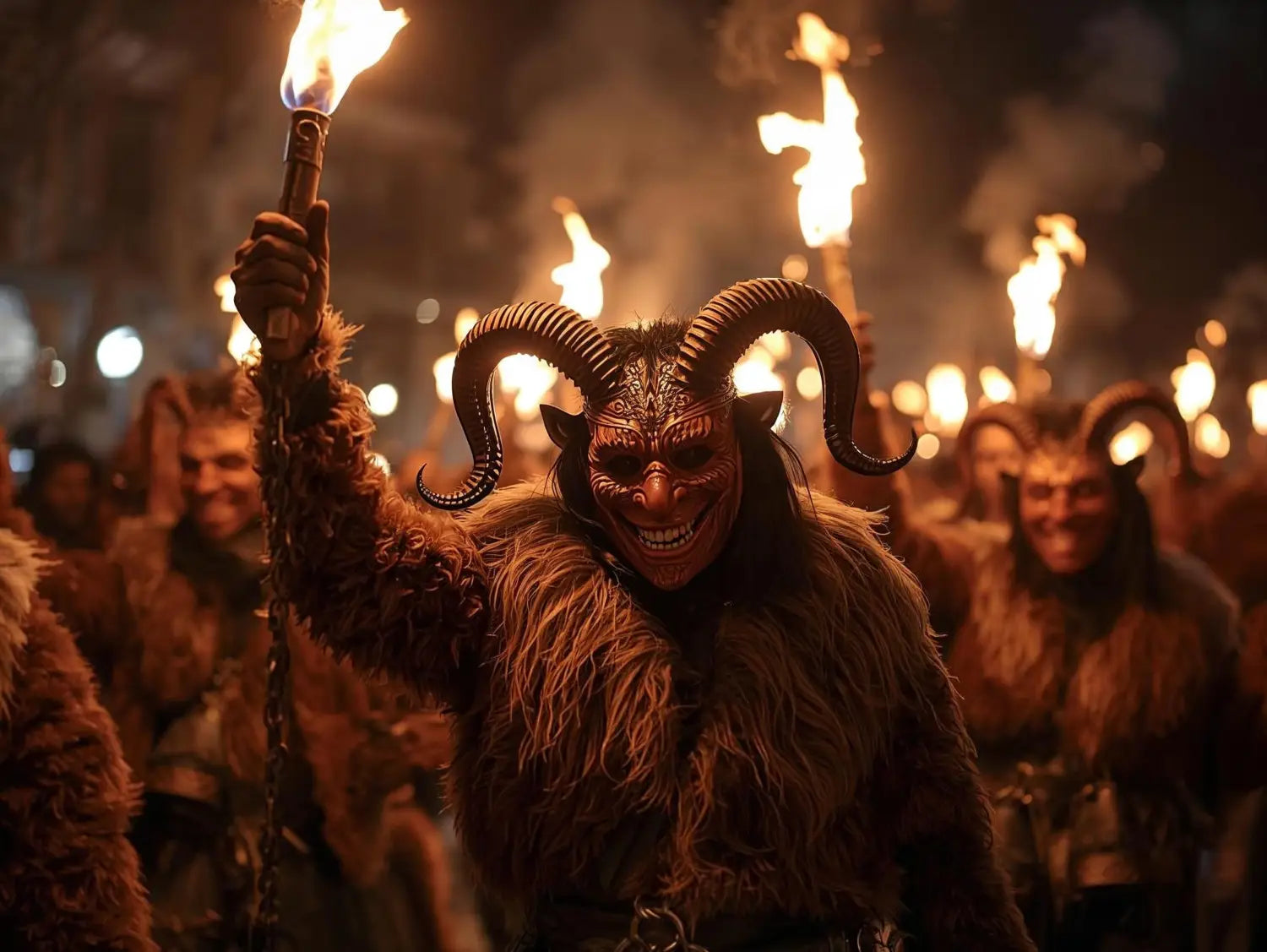
Today, Krampusnacht has grown into festivals with masks, parades, and torchlight—beautiful, chaotic displays that keep the folklore alive.
The Symbolism of Krampus
At first glance, Krampus seems like a creature designed to frighten.
But like many old-world figures, his symbolism is layered.
1. The Horns and Hooves
These traits connect him to wild nature—forces beyond human control. Winter, storms, hardship, the untamed wilds. Krampus represents the side of nature that demands respect.
2. The Chains
Often seen wrapped around his torso or dragging behind him. Some say they symbolize the binding of chaotic forces after Christianity arrived. Others see them as the weight of consequence—chains forged by one’s own actions.
3. The Birch Rods
In ancient times, birch branches were symbols of purification, discipline, and even rebirth. The birch grows even in harsh climates, becoming a metaphor for resilience. Krampus’s birch bundle is not a weapon—it’s a warning.
4. The Sack or Basket
Folklore says Krampus carries a basket to take away the worst-behaved children, but deeper interpretations see this as symbolic: removing negativity from the household, taking away what threatens harmony.
Krampus is not the villain.
He is the winter mirror—reflecting the behaviors that need mending.
Why the Krampus Legend Endures
Legends survive because they serve a purpose.
Krampus endures because he speaks to something universal: we all carry light and shadow, good intentions and mistakes. The Krampus–Saint Nicholas pairing acknowledges a truth that many traditions avoid—morality is not one-sided.
The old cultures understood that teaching goodness requires more than rewards. It requires accountability, boundaries, and reminders that the world has structure.
Winter, especially in Alpine regions, was once a life-and-death season. Food was scarce, warmth precious, and survival relied on cooperation. Stories like Krampus helped keep communities aligned—building resilience through narrative.
Today, even as winter is no longer a threat, Krampus still resonates.
He reminds us:
-
that consequences exist,
-
that tradition has value,
-
that not all darkness is malice,
-
and that the human psyche needs both heroes and shadows.
Krampus in the Modern Age
As folklore spreads beyond its homeland, Krampus has found new life. Films, festivals, artwork, and themed nights have brought him to global audiences. Some depictions exaggerate his monstrous side, but the core idea remains intact: winter is a season of reflection, correction, and renewal.
Across Europe, Krampuslauf—Krampus runs—draw crowds as masked performers thunder through the streets with bells and torches. In Austria, children still leave their shoes out for Saint Nicholas while knowing the darker companion walks nearby.
Even outside Europe, Krampus has become a symbol of winter subculture, embraced by communities who appreciate tradition, mythology, and seasonal ritual.
The Poetry of the Winter Shadow
Every season has its archetype.
Spring brings rebirth, summer brings vitality, autumn brings reflection.
Winter brings truth.
Krampus embodies that truth:
the idea that shadow teaches as much as light,
that discipline shapes character,
that mythology carries wisdom across centuries.
And so he walks—hooves crunching on snow, bells echoing in the cold—side by side with a saint.
Not as an enemy, but as balance.