
Drakkar: The Viking Longship That Conquered the Seas
Few vessels in human history have inspired as much awe and fear as the Drakkar — the iconic longship of the Vikings. Sleek, fast, and built for the open ocean, these ships were not merely tools of war. They were extensions of the Norse soul: crafted for exploration, conquest, and the relentless pursuit of glory across the world's most unforgiving waters.
What Is a Drakkar?
The word Drakkar comes from the Old Norse drekinn, meaning "dragon." The name was no accident. The prow of these ships was carved into the shape of a fearsome dragon or serpent head — a deliberate symbol designed to strike terror into enemies and ward off the evil spirits of the sea.
Technically, "Drakkar" refers to the largest class of Viking longships, reserved for chieftains, jarls, and kings. Smaller longships were known as snekkja or karvi, but it was the Drakkar that became the enduring symbol of Viking naval supremacy.
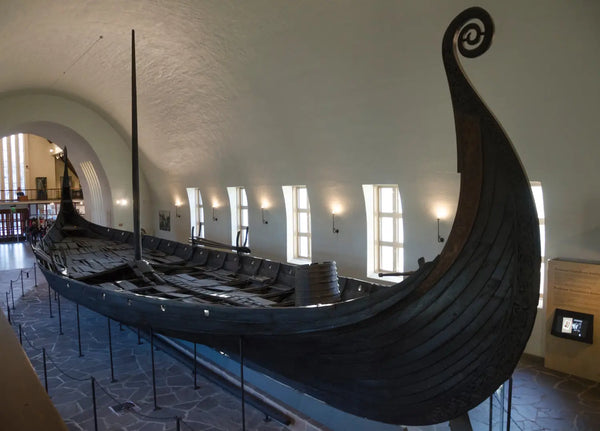
Material and Sail Construction
The Design: Engineering Ahead of Its Time
The Drakkar was a masterpiece of Norse craftsmanship. Built using the clinker method — overlapping planks of oak riveted together — the hull was both incredibly strong and remarkably flexible. This flexibility allowed the ship to bend with ocean waves rather than break against them, making it seaworthy in conditions that would destroy lesser vessels.
Key design features:
- Shallow draft: Could sail in waters as shallow as one meter, allowing Vikings to navigate rivers deep into foreign territories and beach directly on shores without a harbor
- Double-ended hull: Symmetrical bow and stern meant the ship could reverse direction instantly without turning — a critical tactical advantage in battle
- Oars and sail: A large square wool sail enabled ocean crossings, while oars gave precise control in shallow waters or during combat
- Lightweight construction: Despite their size, Drakkar longships could be carried overland by their crew — giving Vikings unmatched strategic mobility
The largest Drakkar on record, Ormen Lange (The Long Serpent), built for King Olaf Tryggvason around 995 AD, measured over 45 meters and required a crew of up to 70 oarsmen.

Ship Construction and War
The dragon head at the prow was more than decoration. In Norse belief, the dragon (dreki) was a creature of immense power — a guardian and a destroyer. By placing its likeness at the front of their ships, Vikings were invoking that power for themselves.
Norse law actually required crews to remove the dragon heads when approaching friendly shores, so as not to frighten the land spirits (landvættir) of allied territories. This detail alone reveals how deeply the symbolism was embedded in Norse culture and daily life.
Where Did the Drakkar Sail?
The reach of the Drakkar was extraordinary. Viking longships carried Norse warriors and explorers to:
- England and France — raiding monasteries and coastal settlements from the late 700s AD
- Russia and the Byzantine Empire — via the great river systems of Eastern Europe, establishing trade routes and founding cities like Novgorod and Kiev
- Iceland and Greenland — settled by Norse colonists in the 9th and 10th centuries
- North America — Leif Eriksson reached Vinland (modern Newfoundland, Canada) around 1000 AD, nearly 500 years before Columbus
This was not luck or accident. It was the Drakkar that made it possible — a ship so advanced it remained unmatched in European waters for centuries.
The Crew: Brotherhood of the Sea
A Drakkar was crewed by anywhere from 40 to 100 warriors depending on its size. These were free men — bound together by loyalty to their jarl and the shared pursuit of glory.
Life aboard was brutal. There was no shelter from the elements, no privacy, no comfort. Crew members slept on deck wrapped in animal skins, ate dried fish and hardtack, and rowed for hours through freezing seas. What drove them was a combination of economic necessity, the Norse warrior code, and the deeply held belief that a life of legendary deeds was the highest achievement a man could reach.
The Legacy of the Drakkar
The age of the Drakkar lasted from 793 AD — the raid on Lindisfarne, considered the beginning of the Viking Age — to around 1100 AD, when the Christianization of Scandinavia and shifts in European politics gradually ended the era of Norse expansion.
But the Drakkar never truly disappeared. It lives on in:
- Museum collections — the Roskilde Ship Museum in Denmark houses five original Viking ships recovered from the seabed
- Modern replicas — crews have sailed reconstructed longships across the Atlantic, proving their remarkable seaworthiness
- Culture and art — from literature and film to sculpture and jewelry, the dragon ship remains one of the most powerful symbols of human courage and ambition
The Vikings who sailed these ships understood something timeless: that the greatest achievements in life require the courage to leave the shore.
At Northlord, we've been inspired by Norse history and craftsmanship since day one. If this world resonates with you, explore our collection of handcrafted Norse jewelry — made in 925 sterling silver and bronze, for those who carry the spirit of the North
Northlord Team
4 comments
nvm sorry about that
who was the auther
how much cost a drakkar in viking age? in silver